The Try-On Haul That Finally Shows You What’s Worth Keeping—and What’s Just Pretty on the Hanger
The Try-On Haul That Finally Shows You What’s Worth Keeping—and What’s Just Pretty on the Hanger
I used to trust a good try on haul the way people trust a flattering mirror. That was a mistake.
One of the clearest examples was a cream knit top I was sure I’d keep because it looked expensive on camera and fit the shoulders just right. Then I wore it through a normal day: coffee run, laptop bag, subway heat, one meeting, one grocery stop. By noon, the elbows had stretched out, the neckline had slipped wider than I wanted, and every time I lifted my arms, the hem crawled up like it was trying to get away. On the hanger, it was elegant. In motion, it was high maintenance.
That’s the whole point now. A try on haul only helps if it can separate clothes that flatter a still image from clothes that can actually live a life.

A lot of try on haul videos are convincing for reasons that have nothing to do with wearability. The lighting is soft. The camera sits a little high, which stretches the body. The creator turns at just the right angle so the side seam disappears. The cuts are quick enough that you never have to sit with the awkward part of a garment, like a waistband digging in when someone sits down or a sleeve twisting after one reach. It’s not some grand deception. It’s just editing doing what editing does: removing friction.
That’s why so many people end up with closets full of “almost.” Almost fits. Almost feels like me. Almost works with jeans. The problem is that almost is expensive. It eats money, attention, and hanger space.
What I ask during a try on haul now is very plain: can this piece enter a capsule wardrobe without making the rest of my closet work overtime?
If the answer is no, I don’t care how pretty it looked in the mirror.
The test I use now is boring on purpose
I stopped judging clothes by the front view alone. That’s how you get fooled by a top that looks perfect while standing still and falls apart the second you move.
My home try-on rule is simple: if I can’t build at least 3 everyday outfit ideas around it in under 60 seconds, it goes back. Not maybe. Not “I’ll think about it.” Back.
That sounds strict, but it saves me from my own mood swings. A garment has to work with the shoes I already own, the bag I actually carry, and the kind of week I really live, not the imaginary version where I’m somehow always in a rooftop brunch mood.
Here’s what I check in practice:
- Does the fabric wrinkle the second I sit down?
- Does it cling in weird places after 10 minutes of wear?
- Can I raise both arms without the hem climbing up?
- Does it still look intentional with flats, not just heels?
- Would I reach for it on a tired Tuesday?
That last one matters more than people admit. A lot of clothes are made for the person you are on your most optimistic day. Real wardrobes are built for the person who is late, carrying too much, and trying not to spill iced coffee on themselves.
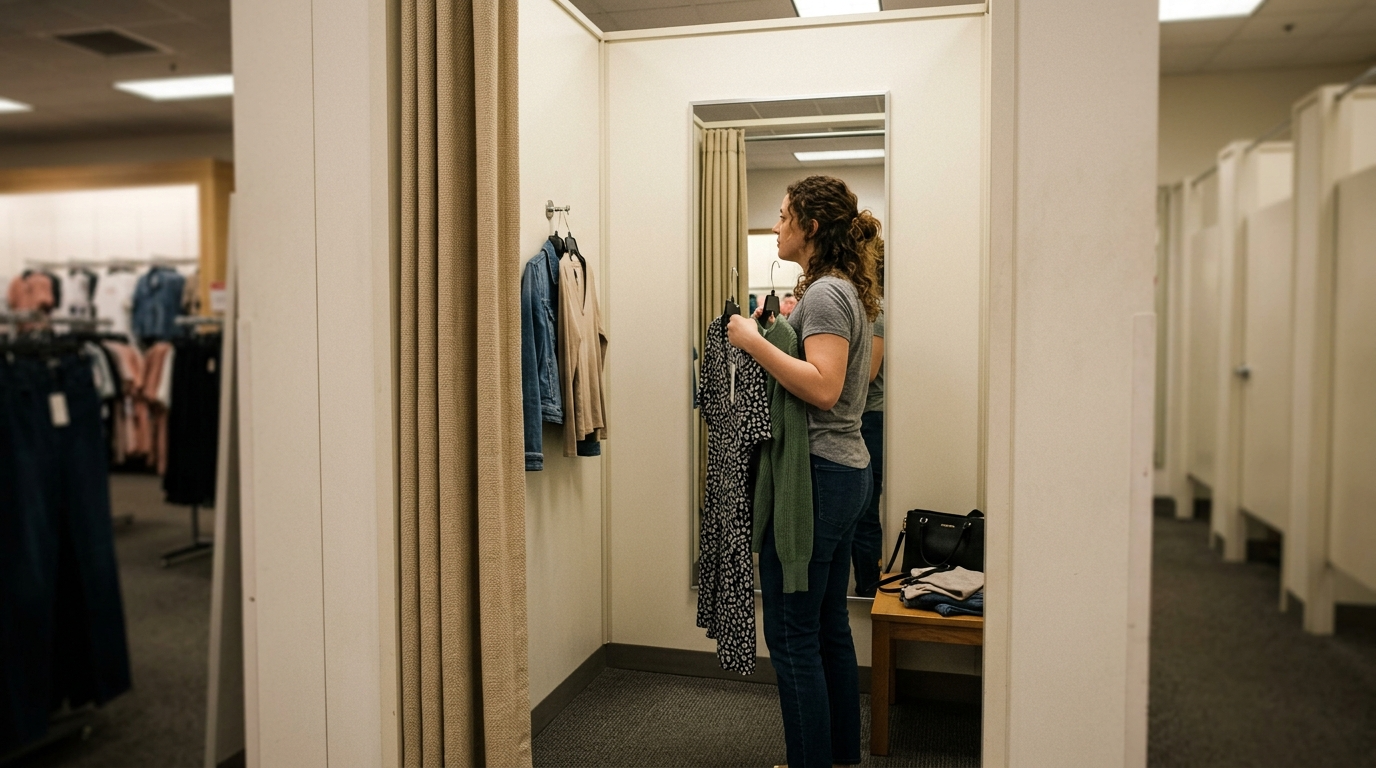
A good example: I once tried on a pair of wide-leg trousers that looked great in the fitting room. The drape was clean, the waist sat neatly, and the color worked with half my tops. But the fabric had this faint swishy stiffness that made every step feel louder than it should have. At home, I realized they were the kind of pants that announce themselves before you do. Pretty, yes. Quietly useful, no.
That’s the difference between a shopping decision and a costume decision.
Why some haul videos make bad purchases feel smart
People don’t just buy clothes. They buy identity signals.
That’s why try on haul videos can hit so hard. They don’t only show a dress or a blazer. They show the feeling of becoming the version of yourself who already owns the dress or blazer. Social proof does the rest. If 40,000 comments say “need this,” your brain starts treating the item like a shared truth instead of a personal fit question.
Loss aversion makes it worse. Once you picture the item as yours, returning it feels like giving something up. Even if the thing was never right, the return starts to feel like a tiny failure. So you keep it. Then it hangs there, collecting dust and guilt.
That’s how almost-right clothes survive.
This is also why a cleaner framework helps. If you already know your closet is built around a capsule wardrobe, the decision gets less emotional. You’re not asking, “Do I like this?” You’re asking, “Does this earn its place?”
That shift sounds small. It isn’t.
If you want a practical reference point, a The Ultimate 10-Piece Spring Capsule Wardrobe mindset is useful even when you’re not building a literal 10-piece closet. It forces you to think in combinations, not single-item dopamine.
The items worth keeping have a very specific energy
The best pieces in a try on haul usually don’t scream. They just cooperate.
They don’t need special underwear. They don’t demand a certain pose. They don’t only work under perfect lighting. They survive a chair, a commute, and a wash cycle. They make outfit math easier instead of harder.
I’ve noticed a pattern: the keepers are often the pieces that look slightly less exciting in a 10-second video but become indispensable in real life. A neutral tee that holds its shape. A blazer that doesn’t pull across the back. Jeans that don’t need a ceremony to zip. If you want to make neutral dressing feel less flat, this is where How to Style Neutral Colors Without Looking Boring becomes more than a style article. It’s basically a reminder that quiet pieces need structure, texture, and repeatability to earn their keep.
The pieces that fail usually fail in one of three ways:
- They look better standing than sitting.
- They need constant adjusting.
- They only work as a single outfit, not a system.
That last one is the killer. A top that only works with one skirt is not a wardrobe item. It’s a hostage situation.
My return rule is simple, and it has saved me a lot of money
If an item fails in two different real-life tests, I return it.
Not one test. Two.
For example, if a shirt looks good in the mirror but wrinkles badly after a 20-minute wear test, that’s one strike. If it also doesn’t work with my usual jeans-and-blazer combo, it’s out. No debate. No “maybe if I style it differently.” If a piece needs that much negotiation this early, it’s already telling me something.
This rule matters because returns are not just about money. They’re about mental load. Every kept mistake is a tiny recurring tax. You see it every time you open the closet. You remember the purchase. You feel the mild irritation. That’s decision fatigue with a hanger attached.
And yes, there’s a little identity issue in there too. People keep almost-right clothes because returning them means admitting the fantasy version of the purchase didn’t survive contact with reality. That stings. But the sting is cheaper than storing regret.
What I’d keep from a haul, and what I’d send back
When I watch try on haul videos now, I’m not looking for “best dressed.” I’m looking for evidence.
Did the fabric recover after sitting? Did the hem stay put? Did the creator show the back, the side, the movement, or just the flattering front angle? Did the piece seem like it could live in a real wardrobe, or was it only built for a reveal?
That’s the filter.
A good haul should help you answer what’s worth keeping, not just what’s worth wanting. If it doesn’t do that, it’s entertainment with a shopping cart attached.
The cleanest judgment I can give is this: keep the clothes that make your week easier, not the ones that make a thumbnail prettier. The hanger is where clothes audition. Your life is where they get hired.